

In advancing patient engagement within clinical operations, the critical insight lies not in fragmented tactics but in adopting a cohesive framework anchored by strong governance, clear strategic goals, and inclusive stakeholder involvement. Governance creates the necessary infrastructure to unify data, align teams, and ensure accountability, transforming engagement from a one-off project into a sustainable organizational priority.
Defining and measuring clinical and operational objectives ensures that patient engagement efforts directly contribute to improved outcomes and workflow efficiencies. Equally important is the meaningful inclusion of patients and frontline staff in design and execution, fostering authentic partnerships that respect patient perspectives and prepare teams to support new communication models. This holistic approach fosters resilience, scalability, and agility in engagement initiatives, positioning clinical operations as central drivers of patient-centered care innovation and quality improvement.
This blog builds on the Engagement Best Practices, describing tactics proven to increase initial patient engagement. I will provide guidance on both specific Organizational approaches and how to maximize the benefits you get from QliqSOFT’s Digital Communication Platform, Quincy, to optimize engagement.
Read Also: Silver Surge – The Rise of Texting Among Seniors
Your engagement rate is directly related to the level of trust you build with the recipient that the secure link is legitimate and can be trusted.
Organizational actions
For organizations adopting proactive digital outreach for the first time, building patient awareness and trust is foundational to success. Trust begins with transparency—clearly communicating who you are, how patient data will be used, and ensuring every digital interaction is secure and HIPAA-compliant helps alleviate patient concerns about privacy and phishing. Education campaigns, leveraging social media, which explain the benefits of digital outreach—such as convenience, streamlined communication, and enhanced care preparation—foster patient buy-in.
Involving staff in patient education and enabling them to reinforce the legitimacy of communications during patient interactions creates consistency that patients notice and appreciate. Provide patient-facing staff with talking points about your new digital communication program, including where they can direct patients with additional questions. Create posters and placards that describe your commitment to simplifying communication with patients.
System Considerations
Branding
MMS (Multimedia Messaging Service) is a messaging technology that enables users to send multimedia content, including images, videos, audio, and slideshows, via mobile phones, thereby extending beyond the text-only limitations of SMS (Short Message Service). Unlike SMS, MMS supports larger message sizes and richer content, making it more suitable for engaging communication. In healthcare, MMS enhances patient communication and provider collaboration. This capability makes MMS a valuable tool for personalized communication with patients and care teams.
Adopting MMS and including your logo in outbound text messages conveys a sense of familiarity and increases response rates compared to simply sending a text message.
Add your logo to recipient emails. Personalize the email footer for your organization and include both email and phone contact information for individuals with questions. Ensure that the individuals responding to the email or phone number are aware of your digital communication program and can effectively address any questions.
Message Content
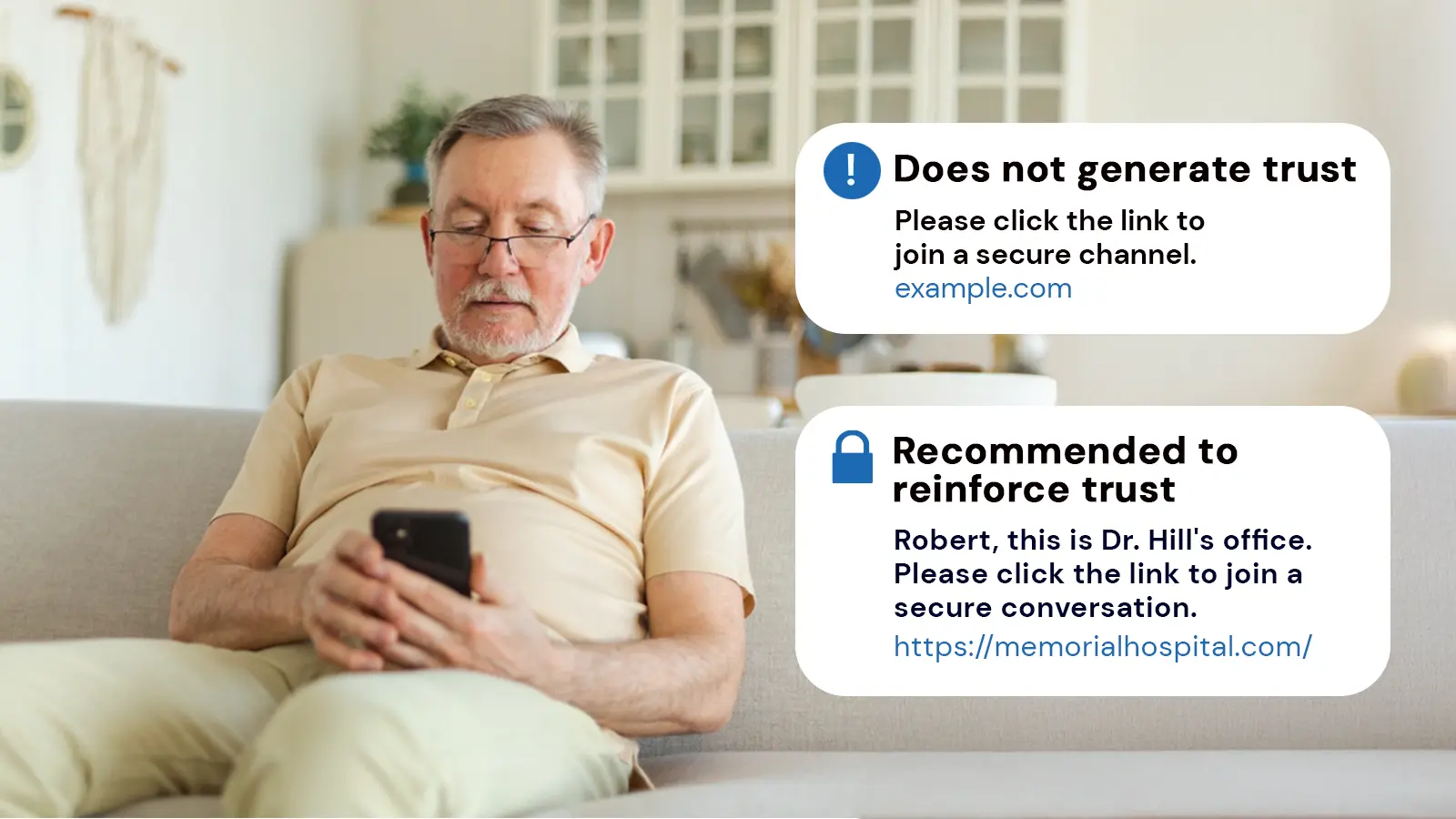
Resist the temptation to use a generic statement for all text or email messages. Patients see them as spam and are unlikely to trust the message enough to click the link to open the secure channel.
Remember, this first message is not secure, so it may not contain any protected information
Personalized, messaging that reflects genuine care, rather than generic blasts, can more effectively engage patients and make them feel valued.
Look beyond simply providing the required data elements for each patient. Consider, for example, including the patient’s specific doctor or clinic name (if you have multiple) so that you can use custom attributes in your message. Consider the following options. Which would motivate you to respond?
URLs
The default URL used in widgets is a qliqsoft.com URL. Organizations have the option to change the URL to a URL from their organization that will be more familiar to the patient. A custom URL:
- Builds patient trust by clearly indicating the link is from their healthcare provider, reducing suspicion and increasing the likelihood that patients will click the link safely.
- Improves patient engagement by making links easy to recognize, track, and manage
- Reinforces the healthcare organization’s brand and professional image, helping patients feel confident and valued.
To do this, you will need to involve the administrator of your organization’s DNS provider, create a subdomain that you can dedicate to QliqSOFT, and coordinate with QliqSOFT to ensure it is working correctly. Contact support or your account lead for detailed instructions.
Opt-in
Offering opt-in choices empowers ownership, helping organizations build a foundation of digital trust that supports long-term engagement and improved care experiences. Opt in automatically generates editable fact sheets about the communication program and enables recipients to easily save the related contact information in their phone, ensuring that future messages are familiar.
Opt-in is set at the widget level, so if an individual opts out of text messaging, it applies only to the topic addressed in the widget, not to all communications sent by your organization. If there is a question about why someone has not received a message from your organization, first check the SMS opt-out report to see if the individual is listed.
Redirects
At times, a recipient will call the number in the text to check its validity. There is an option in the widget to set a phone number that will receive this call. Ensure that the individual(s) with that phone number are familiar with your digital communication plan and can confirm to the caller that the message is legitimate.
We also see times where the patient responds to the text instead of clicking on the link. Use the option in the widget to craft an autoreply that explains the purpose of the outreach and assures the patient that the message is legitimate.
Primary Language
An estimated 25.6 million people in the United States have limited English proficiency (LEP), which is roughly 8–9% of the population across hundreds of spoken and signed languages. Despite this prevalence, only 13% of healthcare organization fully meet translation requirements.
Patients feel respected and heard when outreach is delivered in their own language, which builds trust, high satisfaction scores, and increases their willingness and ability to engage digitally with the care team.
Fortunately, real-time translation is increasingly being adopted by healthcare organizations. Patients are “generally positive” with AI translation, finding that communicating through machine translation was easy and that they are “willing to use the application again
Your QliqSOFT account team will partner with you through each stage of this process: confirming readiness, configuring your branded assets, and validating workflows to ensure every outreach incorporates best practices and builds confidence and trust from the very first message.


