

Executive Summary
The next 14 days after admission set the tone for the entire hospice episode. Families are learning new routines; care teams are establishing cadence; equipment, meds, and expectations all need to click quickly. Gaps here drive avoidable after‑hours calls, ED transfers, and lower satisfaction.
QliqSOFT operationalizes the next two weeks with a customizable engagement program: Day‑0 welcome, early readiness checks, scored symptom/med adherence surveys, and automation that escalates to staff when thresholds are met—with EMR write‑backs and audit trails. The result: faster stabilization, fewer crises, higher caregiver confidence, and consistent documentation from day one.
The next two weeks set the tone for the entire hospice journey—done right, they prevent crises, build confidence, and stabilize care.
Understanding the Problem
On Monday morning, a new patient was discharged home, and their family had no clear sense of what to expect during the first week. They weren’t sure if the equipment was set up correctly, if the medications were being given as intended, or what rules applied after hours. Intake staff had sent notes by email, while the field team started visits without seeing all the details, so small changes in the patient’s symptoms went unnoticed until they became urgent. When questions about adherence, equipment, and risks arose, documentation was patchy, leaving an incomplete record for handoffs and quality review.

By midweek, the fallout was apparent. The family’s anxiety grew with repeated phone calls for basic guidance. Operations felt the strain: after-hours lines lit up, nurses were pulled into preventable ED transfers within the next 14 days , and staff had to redo Day 0 paperwork that wasn’t completed correctly the first time. Compliance gaps widened, as there was no consistent evidence of education or symptom tracking to demonstrate that visits were timely and appropriate. Financial losses mounted in the background—every missed readiness check meant lost billable days, more overtime, and increased after-hours usage.
What seemed like small cracks on day one had snowballed into stress for families, disruption for staff, compliance risk, and real financial cost.
QliqSOFT The Next14Days Workflow: Coordinated, Clear, Confident
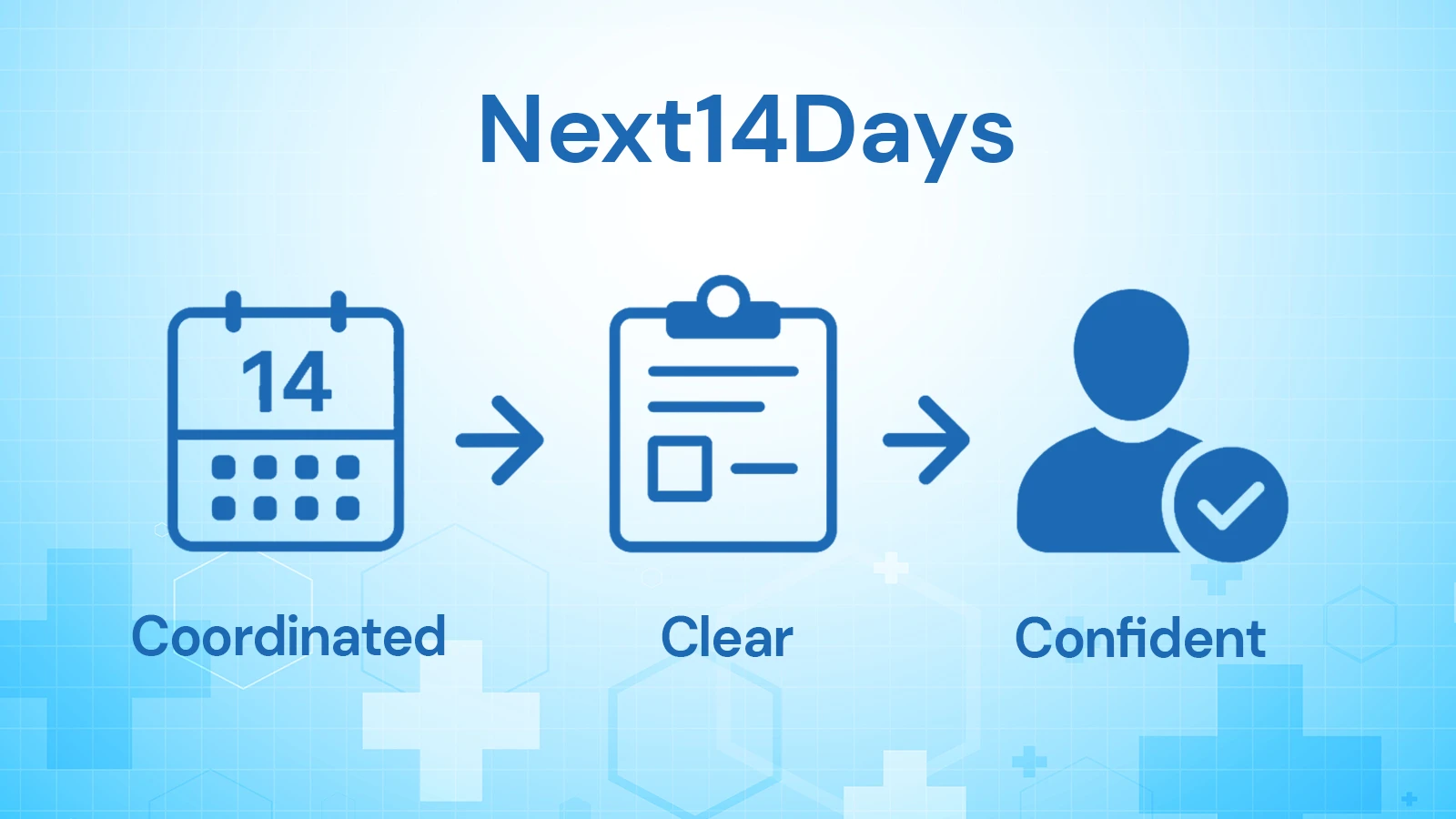
When a patient comes home on hospice services, the next two weeks are often the most uncertain. With QliqSOFT’s Next14Days Workflow, that uncertainty turns into a guided path.
On Day 0, the family receives a warm welcome message and a secure link explaining who their care team is, how to reach them 24/7, and what to expect in the days ahead. A quick readiness checklist—“Do we have the equipment? Who will give meds?”—helps everyone start with clarity.
By Days 1–3, the family gets short, plain-language updates that set expectations: when is it urgent enough to call versus safe to message? This ensures they feel supported without second-guessing every situation. They also confirm their preferred contact time and number, ensuring smooth communication.
Next, during Days 2–7, caregivers complete simple symptom and medication check-ins, including pain, breathing, bowel habits, and PRN use. The responses aren’t just filed away; they’re scored in real-time, with any concerning trends triggering proactive nurse outreach before small changes become emergencies.
Between Days 4–10, automation kicks in to expand the circle of care. Social work and chaplain introductions are scheduled, equipment placement has been double-checked, and learning resources have been sent. Nurse calls are teed up seamlessly, so families are never left waiting for the next step.
Finally, by Days 8–14, the clinical team comes together. They review the family’s reported trends, update the care plan if necessary, document the education that has been provided, and—most importantly—check in on the family’s confidence. Everything syncs back to the EMR, leaving a clean record and a strong foundation for ongoing care.
What once felt like a fragile, anxious next two weeks now becomes a coordinated, clear experience—families are confident, staff are proactive, and care is aligned from day one.
Regulatory & Compliance Considerations
- HIPAA: all PHI is behind secure links; submissions are encrypted and time‑stamped.
- TCPA: Opt‑out language; quiet‑hours honored.
- CMS: Structured fields support timely documentation and required RN visits in the next 14 days.
- SOC 2: QliqSOFT maintains SOC‑aligned controls.
QliqSOFT’s Next14Days Solution
QliqSOFT’s solution contains:
- Customizable surveys/assessments: Readiness (DME, comfort kit, safety), Symptom + Med Adherence, Caregiver Confidence pulse.
- Scoring & Routing: Thresholds escalate to RN/MSW/Chaplain.
- Automated Campaigns: Welcome touchpoints, education nudges, appointment confirmations, and reminders.
- Integration: Webhooks + API/HL7/FHIR/SFTP/CSV write‑backs.
- Reporting: Message delivery, response rates, self-assessment analytics, trend views, caregiver satisfaction and confidence, symptom and medication adherence, time to first contact, appointment confirmations.
Best Practices
- Keep messages short with one clear Call to Action.
- Always include the 24/7 number and when to call vs. submit form.
- Respect language & accessibility preferences.
- Confirm who gives meds and who to call first.
- Standardize templates, allow local personalization.
- Close the loop: always confirm receipt with caregivers.
Implementation Plan (30 Days)
This solution can be implemented quickly, as illustrated in the following example.
Prerequisites: Form the project team. The hospice provides a list of certifying clinicians, current documents, escalation rules, and baseline performance metrics.
Week 1: Finalize content, questions, and thresholds; confirm opt-out and quiet hours; map roles.
Week 2: Configure assessments & automations; set webhook endpoints; prepare EMR write‑back.
Week 3: Pilot on one team/site; validate scoring vs. clinician judgment; tune thresholds.
Week 4: Train staff, expand system‑wide, monitor KPIs daily for two weeks. Adjust the solution, as needed.
Month 6: Determine current KPI performance and measure improvement.
KPIs to Track
- Delivery/response rates (Day 0, 3, 7, 14).
- Median time: form submission → RN outreach.
- % flagged by risk score and resolved within SLA.
- No shows/missed visits.
- Day‑7 readiness complete rate.
- Caregiver confidence pulse.
- Documentation completeness: forms, education, EMR write‑backs.
- Patient/caregiver satisfaction.
Conclusion
The next 14 days can be predictable and manageable—if you standardize them. QliqSOFT delivers customizable assessments, automation, and integration so stabilization is the norm, not the exception. This is the clinical and operational foundation for trust, safety, and speed.


