

Your bereavement coordinator just quit. They left behind a spreadsheet with 247 families, Post-it notes with follow-up dates, and a calendar full of reminders that only they understood. Sound familiar? This is bereavement management at most hospices: a house of cards built on manual processes and good intentions.
Yet for many hospice providers, bereavement remains one of the most manual, under-resourced, and operationally vulnerable parts of the organization.
Paper lists. Spreadsheet trackers. Staff memory. Calendar reminders.
Well-intentioned efforts, but difficult to sustain at scale.
Hospice leaders need a bereavement program that honors each family's grief while protecting already-stretched teams from another manual burden. QliqSOFT's hospice bereavement solution transforms the 13-month requirement into a structured, risk-informed, and compliant workflow, without sacrificing compassion.
Bereavement Is Both Mission and Mandate
Under the Medicare Conditions of Participation, hospices must:
- Conduct a bereavement risk assessment
- Provide services based on identified levels of risk
- Maintain documentation of outreach and interventions
- Demonstrate follow-up across the 13-month post-death period
In practice, this means hospices must move beyond "checking the box." A compliant program requires timely assessment, structured follow-up, and defensible documentation; all while navigating staffing shortages and compassion fatigue.
The most effective bereavement models use a tiered approach:
- Low risk: periodic supportive outreach
- Moderate risk: increased check-ins and resource support
- High risk: active intervention and referral
But implementing a tiered model requires data, visibility, and workflow discipline; something many programs struggle to maintain with manual processes.
QliqSOFT helps hospices operationalize this model in a way that aligns with both mission and regulation.
As a former assistant pastoral minister, I've seen how powerful presence can be, says John Lovitsch, QliqSOFT Product Manager. This solution allows hospice teams to be present in a structured way, through two-way check-ins that surface risk early and ensure families are not overlooked.
John's perspective reflects the human core of bereavement care. Operationally, that compassion must be supported by an infrastructure that ensures no family is missed and no requirement is overlooked.
As a hospice operator and healthcare executive, I've seen how bereavement programs often become the most fragile part of the organization, not because teams don't care, but because they're trying to manage a 13-month clinical and regulatory responsibility with manual systems, says Michelle Pickering, Chief Operating Officer at Momentum HT Consulting and Strategic Advisor to QliqSOFT.
When compassion relies on spreadsheets and memory, risk increases, both for families and for compliance. Structured workflows allow teams to focus on human connection while protecting the organization.
What QliqSOFT's Hospice Bereavement Solution Enables
QliqSOFT weaves bereavement into your broader communication and documentation ecosystem, so no family is forgotten, and no requirement is missed.
Key capabilities include:
- Risk-based digital assessments that classify bereavement level (low, moderate, high) and trigger appropriate escalation
- Automated 13-month outreach cadences aligned with Conditions of Participation timelines
- Secure, HIPAA-compliant messaging and digital forms that allow families to respond on their own time
- Structured documentation outputs that create survey-ready records of outreach, assessment, and follow-up
- Configurable workflows that align with your IDG processes and bereavement plan of care
- Integration options (HL7, FHIR, APIs, PDF) to support your EMR and avoid siloed documentation
For families, this feels like thoughtful, consistent check-ins.
For leadership, it creates measurable, reportable, defensible structure.
Compassion Without Administrative Chaos
Technology in bereavement must feel human.
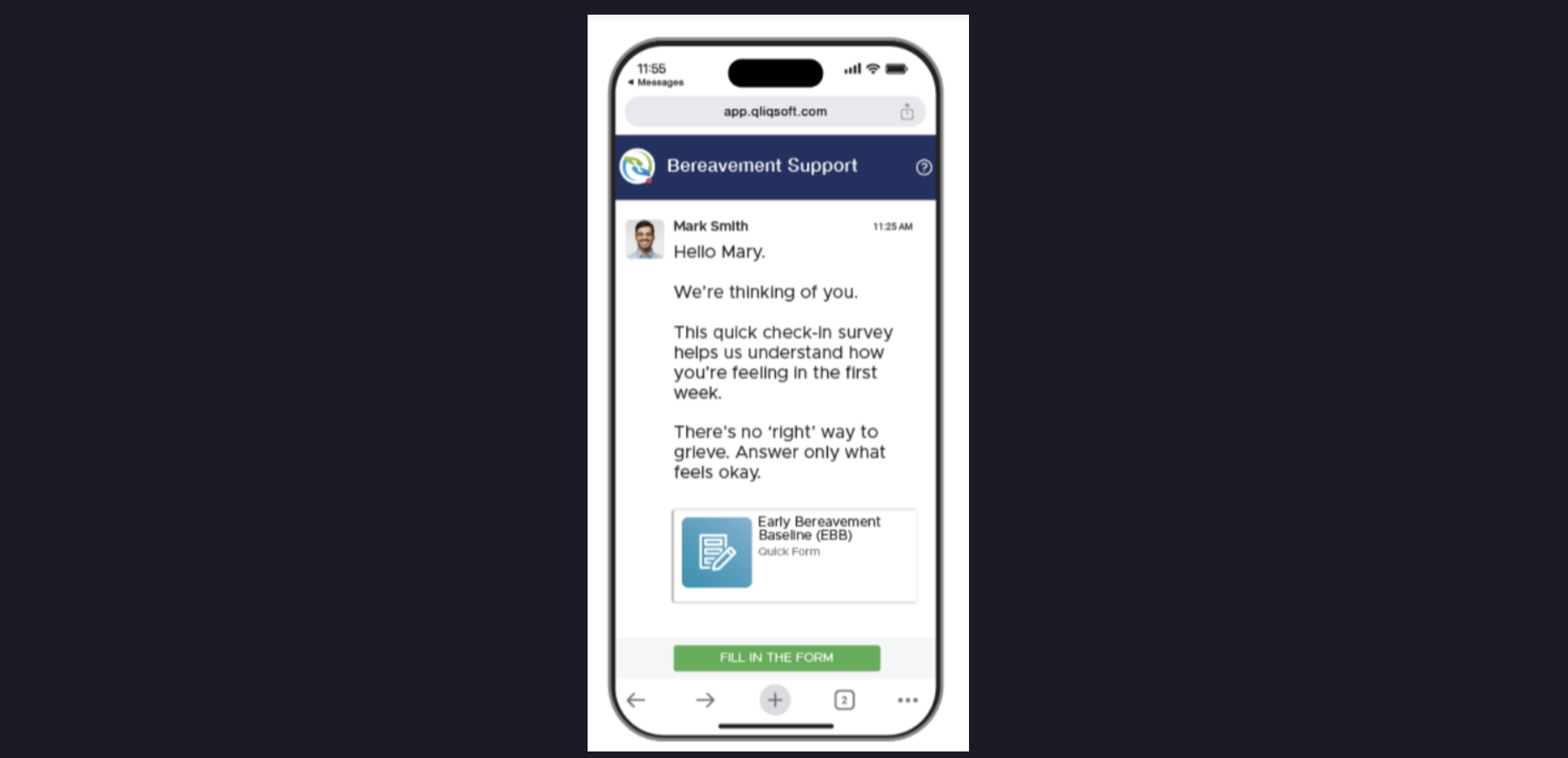
QliqSOFT's mobile bereavement support interface enables compassionate, structured check-ins with families
Hospices can:
- Send warm, plain-language outreach at meaningful milestones (first weeks, holidays, anniversaries)
- Offer brief, empathetic digital assessments to understand coping and support preferences
- Automatically notify bereavement staff when responses indicate increased distress
- Track engagement, declined services, in-person requests, and completion of required outreach
Example: A caregiver receives a message prior to the first holiday after loss, inviting an optional check-in. If responses suggest isolation or worsening grief, the system flags the case for personal outreach, supporting earlier intervention, without relying on memory alone.
This approach strengthens both care and accountability.
Protecting Staff While Strengthening Survey Readiness
Bereavement services are included in the hospice per diem. They are not separately reimbursed. This makes operational efficiency essential.
QliqSOFT's hospice bereavement solution:
- Eliminates manual spreadsheets and disconnected tracking systems
- Logs outreach attempts, assessments, and responses automatically
- Creates auditable records for surveys and accreditation reviews
- Reduces after-hours burden through asynchronous response models
- Provides reporting dashboards with monthly and annual views, including drill-down detail
For hospice executives, this means the ability to answer confidently:
- How many families were assessed?
- How many declined services?
- How many required escalations?
- Were all 13-month touchpoints completed?
Compassion is preserved. Compliance is protected.
Implementation Without Disruption
Modernizing bereavement workflows should not require a massive IT overhaul.
A phased approach works best:
- Launch with a pilot cohort
- Implement core risk assessments and a simple outreach cadence
- Align documentation with IDG workflow
- Expand gradually to all bereaved families
- Add specialized pathways (pediatric loss, traumatic death, high-risk families)
Because QliqSOFT is configurable rather than custom-built, teams can implement without overwhelming staff.
A Hospice Bereavement Solution That Honors Both Heart and Regulation
Hospice leaders do not see bereavement as a compliance obligation alone. It is a sacred trust.
At the same time, today's environment demands documentation discipline, staffing sustainability, and defensible processes.
A purpose-built hospice bereavement solution from QliqSOFT allows organizations to:
- Deliver risk-informed, compassionate outreach
- Reduce administrative burden
- Strengthen survey readiness
- Support IDG coordination
- Sustain meaningful family connection beyond the moment of death
Compassion and compliance are not opposites.
With the right infrastructure, they reinforce one another.
Ready to Transform Your Bereavement Program?
Learn how QliqSOFT's hospice bereavement solution can help your organization deliver compassionate, compliant care at scale.
Request a Demo


